

Illustrative discussion of a planned surgical tooth extraction
Specialized Care

Surgical Tooth Extractions in Old Milton

A tooth that has carried fillings and crowns for decades can eventually break down to the gumline. From Old Milton, talk with us about whether what remains can be saved, why surgical access may be needed if not, and how comfort and healing will be handled.

When years of repairs finally give way

The crown has snapped off. Now what about the root?

It often happens over something ordinary, like a crust of bread or a handful of nuts. A molar that has been filled, refilled and perhaps crowned over many years cracks, and what is left sits level with the gum or below it. With so little to hold onto, a straightforward lift is not always possible. Reaching the root may mean easing back some gum, removing a small amount of bone, or dividing the remaining tooth so each piece comes out in turn.

Before anyone talks about technique, the first conversation is whether removal is the right call. Sometimes a broken tooth can still be rebuilt; sometimes it cannot. Ask what the examination shows, whether a tooth-saving route is realistic, and what each choice would mean. Surgical is a description of the method, and it should never stand in for the reason.

For people in Old Milton, our Bronte Street practice is a short way from the historic downtown. We can go through the findings, outline a sensible pathway, and arrange a referral if the complexity or your care needs suit another provider better. Tell us about your health, your medicines and how past dental visits have gone, so the plan covers preparation, comfort, recovery and a contact if anything changes.

Ask about a broken tooth or remaining root
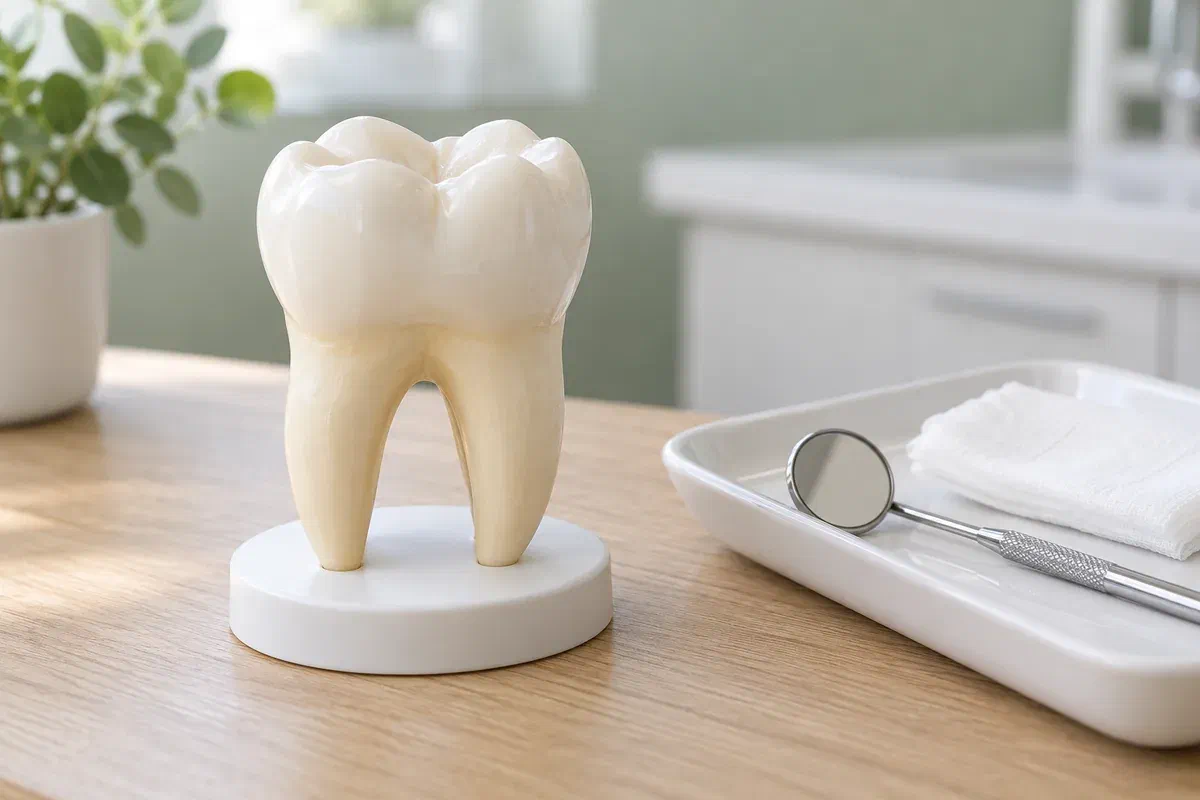
Illustrative two-root molar teaching model beside a dental mirror and gauze
What makes an older tooth harder to remove

Old repairs, brittle walls and hidden roots.

Imaging and a careful examination help show what is going on below the surface. Ask the clinician to explain what they see in your own tooth, since no two surgical extractions follow exactly the same steps or carry the same mix of risks.

The root is sitting below the gum

After a fracture, the part that remains may be covered by gum tissue or bone and impossible to grip from above. The clinician weighs where it sits and why it needs removing before deciding how to reach it. A root being out of sight is not, on its own, proof that it has to come out.

Large fillings have left thin, fragile walls

Teeth with extensive past work can crumble when handled, and long or curved roots add to the challenge. Splitting the tooth into sections is frequently part of the plan from the outset. Ask what the clinician anticipates and how the approach might adapt if things look different once treatment begins.

Neighbouring structures and your health history

Adjacent crowns or bridges, nerves, the sinus above upper back teeth and the surrounding bone can all shape the risks and the case for referral. Long-term health conditions and medicines may change preparation or healing advice. A complete history lets the clinician say which factors genuinely apply.

Keep taking prescribed blood thinners and other medicines unless your clinician advises otherwise. The treating clinician reviews your history and works with your physician or other prescriber on any changes that are truly needed.

What a careful plan gives you

A decision you understand, and less guesswork afterwards.

Thinking ahead helps match the technique, the setting and the support to your tooth before the appointment day. You can reasonably ask how the assessment was done and why this approach was chosen. Risks should be described in terms that relate to you, so you can weigh them, rather than as a long list where every item sounds equally likely.

There is also the question of what fills the space. Some removals are one step in a larger restorative or orthodontic plan; others simply deal with a tooth that cannot be kept. Ask whether a replacement, a period of monitoring or another stage is expected, and whether anything should be coordinated with your existing crowns or bridges first.

Patient information: Liverpool University Dental Hospital — surgical removal of teeth or roots

A clear reason for taking it out

Find out what the extraction is expected to fix and why repair is not suitable or is less appropriate. The clinician should explain the likely benefit and what delaying or declining could lead to. Removal is permanent, so it deserves a discussion grounded in what was actually found.

Comfort arranged around you

Raise local anaesthetic, nervousness, any memories of difficult treatment and whether extra support would help. Surgical removal is not the same as being put under. If a different approach or provider is involved, ask about assessment, transport, an escort or special preparation instead of assuming the usual routine.

Healing that has been thought through

Ask how eating, daily activity, medicines and contact after hours will work. Recovery differs between procedures and people. A sound plan tells you what to expect and who to call, and it names the signs that should be checked rather than waited out.

Four stages, one at a time

Assessment, consent, removal, then aftercare and review.

Bring your questions to the earlier visits rather than the day itself, and agree on a hand signal if you need a pause. Instructions about eating or medicines beforehand come from the treating provider and depend on the anaesthetic and your health.

  1. Examine what remains of the tooth

    The area is checked, appropriate images are considered, and the reason for removal is reviewed alongside your medical details. Ask what approach is expected, which risks stand out and whether referral is advised. Find out whether any other treatment or records are needed before the extraction can reasonably be scheduled.

  2. Agree to the plan and how you will be kept comfortable

    The provider explains the proposed treatment and any reasonable alternatives before asking for consent. Local anaesthetic, and any extra arrangements assessed as appropriate, are discussed. If something still feels sharp or you need a moment, say so straight away rather than putting up with it.

  3. Gain access and lift out the root or tooth

    Gum may be moved aside, a little bone removed or the tooth divided, following the plan and what the clinician finds. Numbing takes away sharp pain, but you may still notice pressure, firm pushing or vibration. The site is then tidied, and the clinician decides whether stitches or other measures are appropriate.

  4. Leave with home care and next steps

    Instructions cover bleeding, keeping the area clean, food, soreness and activity. Ask whether stitches will dissolve or need removing, and whether a review is booked. Make sure you know how to raise a concern, and what the next dental stage is, such as planning a replacement where that fits the reason for removal.

Looking after the site at home

Protect the socket, and watch for the right kind of change.

Your own clinician’s instructions come first. The size of the procedure, your health history and any extra measures can change the advice, so a general list should not overrule the plan you were given.

Keep the clot in place

Resist touching the socket with a finger or exploring it with your tongue. Many instructions ask you not to rinse or spit for the first day, then to start gentle cleaning when told. Go carefully with hot drinks and food, and avoid biting your cheek or lip while sensation is still dulled.

Follow the advice on meals, movement and medicines

Choose soft, comfortable foods and keep to the guidance on exercise, smoking and caring for the site. Use pain relief only as directed and within its labelled limits, bearing in mind your health and other prescriptions. Do not start old antibiotics from the cupboard or change your prescribed medicines without advice.

Know when to pick up the phone

Call about bleeding that persists, pain that is severe or increasing, swelling that keeps growing, fever, or numbness or tingling that worries you. Say when it began and how it differs from what you were told to expect. Not every painful socket is infected, and getting worse is not automatically part of healing.

Patient information: UCLH — protecting the site and following extraction aftercare

Weighing up a broken tooth

Rebuild, remove, or refer: three routes worth comparing.

What makes sense depends on the diagnosis and on what can realistically be done for that tooth. Ask what each choice involves, its limitations, and what leaving things as they are would mean.

When the tooth is a fair candidate for repair

Rebuilding when enough tooth remains

Depending on the problem, a new filling, crown, root canal treatment, gum procedure or other care might be relevant. Ask about the long-term outlook and what the work would require. Some broken teeth cannot be saved, but you should hear why preservation is or is not a reasonable option.

When extraction is advised and the root is hard to reach

Surgical removal, properly planned

The clinician sets out the proposed method and what preparation it needs. Ask which steps are expected and how healing and any later replacement will be handled. Planning should suit the tooth and the person, with no promise of a fixed appointment length or the same recovery for everyone.

When anatomy, complexity or health needs require more input

A specialist view or a change of plan

Referral may help when the anatomy is difficult, risks are higher or care needs go beyond the planned setting. Ask what the specialist will look at and whether any interim care is needed. Now and then the balance of risks alters the removal plan, which only an individual assessment can settle.

Questions about older, heavily repaired teeth

What people in Old Milton tend to ask us.

Note down what is on your mind, whether that is the broken piece, the anaesthetic, healing or the reason for removal. The clinician can explain which concerns relate to your tooth.

(905) 876-4488
Can a tooth that broke at the gumline ever be saved?
Sometimes, depending on how much sound tooth remains below the gum, the health of the root and the surrounding support. Options such as crown lengthening or root canal treatment may be discussed in selected cases. The clinician explains whether repair is realistic after examining the tooth and appropriate images.
Will removing this tooth affect the crown or bridge next to it?
It may need to be considered in the plan. The clinician looks at how neighbouring work is supported and whether it could be affected. Ask how the adjacent teeth will be protected and whether any change to existing restorations should be expected later.
Is it unusual for a tooth to be cut into pieces during removal?
No. Sectioning a tooth or its roots lets the clinician remove it in parts when the shape or access makes that sensible. It is often a planned step rather than a problem. Ask what is expected for your tooth and where there is uncertainty.
Does a long medication list change how the extraction is planned?
It can. Some medicines and conditions affect bleeding, healing or the anaesthetic plan. Bring a full, current list to the assessment. Do not stop anything yourself; the treating clinician reviews it and coordinates with your prescriber if instructions need to change.
Do I always need stitches after a surgical extraction?
Not always. The clinician decides whether closing the site or another measure suits the area. If stitches are placed, ask whether they dissolve or need removing, and what to do if one comes loose or irritates you.
Is the clinic far to come from Old Milton for follow-up visits?
Our Bronte Street practice is close to Milton’s historic downtown, which can make reviews and suture checks easier to fit in. Ask at the assessment whether a follow-up is planned and how to reach the team between visits.
Old Milton extraction planning

Bring the broken tooth question to us early.

Contact Milton Dental Clinic to talk through a fractured tooth, a root left behind or a surgical extraction someone has already recommended. Bring any images or records you have and tell us about your symptoms, health and concerns.

The approach and provider are decided by individual assessment. Please call promptly about urgent symptoms.

Visit Milton Dental Clinic
Unit 1, 342 Bronte St. S, Milton, ON L9T 5B7
Get directions Clinic hours
Monday–Thursday
11am–7pm
Friday–Sunday
By appointment only

Areas we serve

  • Milton
  • Oakville
  • Mississauga
  • Georgetown
  • Halton Hills
  • Acton
  • Campbellville
  • Brampton
  • Burlington
  • Puslinch
  • Rockwood
  • Erin
  • Caledon
  • Etobicoke
  • Old Milton
  • Bronte Meadows
  • Timberlea
  • Dorset Park
  • Dempsey
  • Clarke
  • Beaty
  • Coates
  • Harrison
  • Scott
  • Willmott
  • Ford
  • Bowes
  • Cobden
  • Walker
  • Mountain View
  • Milton Heights
  • Hawthorne Village
  • Valley View
  • Fallingbrook
  • Nassagaweya
  • Trafalgar
  • Esquesing
  • Nelson
  • Brookville
  • Moffat
  • Glen Williams
  • Norval
  • Limehouse
  • Stewarttown
  • Ashgrove
  • Hornby
  • Silver Creek
  • Speyside
  • Scotch Block
  • North Oakville
  • River Oaks
  • Glen Abbey
  • West Oak Trails
  • Palermo
  • Bronte Creek
  • College Park
  • Joshua Creek
  • Uptown Core
  • Preserve
  • Iroquois Ridge
  • Lisgar
  • Meadowvale
  • Meadowvale Village
  • Churchill Meadows
  • Erin Mills
  • Central Erin Mills
  • Streetsville
  • East Credit
  • Creditview
  • Heartland
  • Sheridan
  • Mount Pleasant
  • Credit Valley
  • Huttonville
  • Churchville
  • Springbrook
  • Northwest Brampton
  • Bram West
  • Fletcher's Meadow
  • Fletcher's Creek South
  • Alton Village
  • Orchard
  • Millcroft
  • Headon Forest
  • Tansley
  • Brant Hills
  • Tyandaga
  • Kilbride
  • Lowville
  • Aberfoyle
  • Morriston
  • Arkell
  • Hillsburgh
  • Freelton
  • Carlisle
  • Waterdown
  • Flamborough
  • Mountsberg

How can we help?

Milton Dental Clinic

Have a question about your smile? Choose the option that works best for you.

For urgent dental concerns, please call.
Messages are reviewed during clinic hours.