
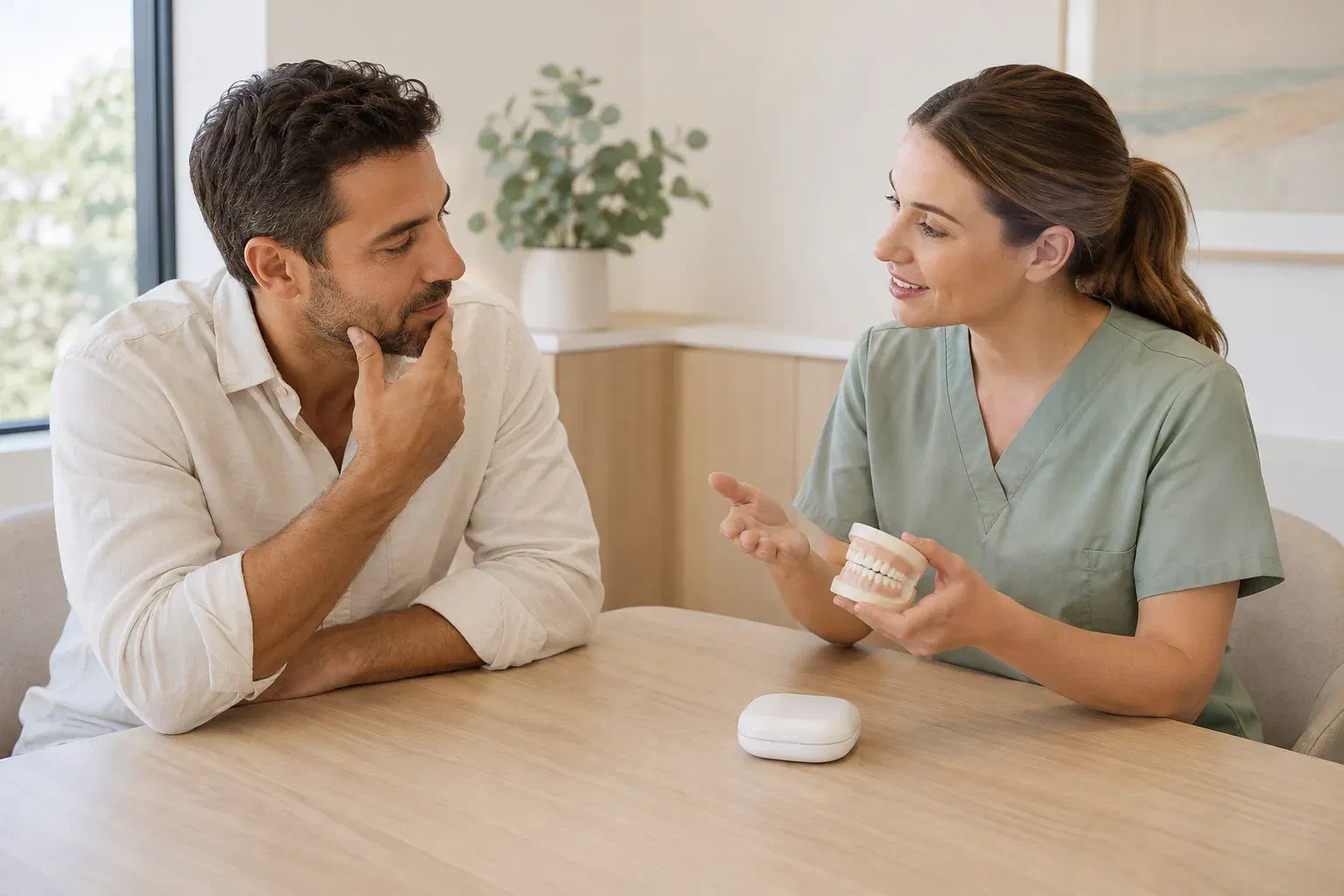
Illustrative consultation about teeth grinding and possible tooth wear
Specialized Care

Teeth-Grinding Treatment in Caledon

Retainers, hockey mouthguards, a nightguard from years ago: many homes have a drawer full of dental appliances, and it is tempting to reach for whichever one is handy. For adults in Caledon worried about grinding, we sort out which device, if any, fits the job.

Caledon: the right appliance for the job

They all look like clear plastic. They are not the same.

An orthodontic retainer keeps teeth where they were moved. A sports mouthguard cushions a blow on the ice or the field. A sleep-apnea appliance, prescribed after a medical diagnosis, is designed around breathing. A grinding guard aims to protect tooth surfaces from the forces of bruxism, the clinical term for grinding and clenching during sleep or waking hours. Each is built differently.

Choosing the right one starts with knowing whether you need any of them. Worn enamel can come from causes other than grinding, and a flat edge that formed long ago says little about current activity. The dentist puts your history, symptoms and the examination together before suggesting whether to monitor, protect, repair or look into something further.

Bring every appliance you currently use or are thinking of using, even the ones that seem unrelated. Tell us who made them and why. If you wear a retainer, the plan needs to respect that too. Our aim is a clear purpose for each device, and we will not claim that any of them will put an end to grinding permanently.

Sort out which appliance suits your grinding
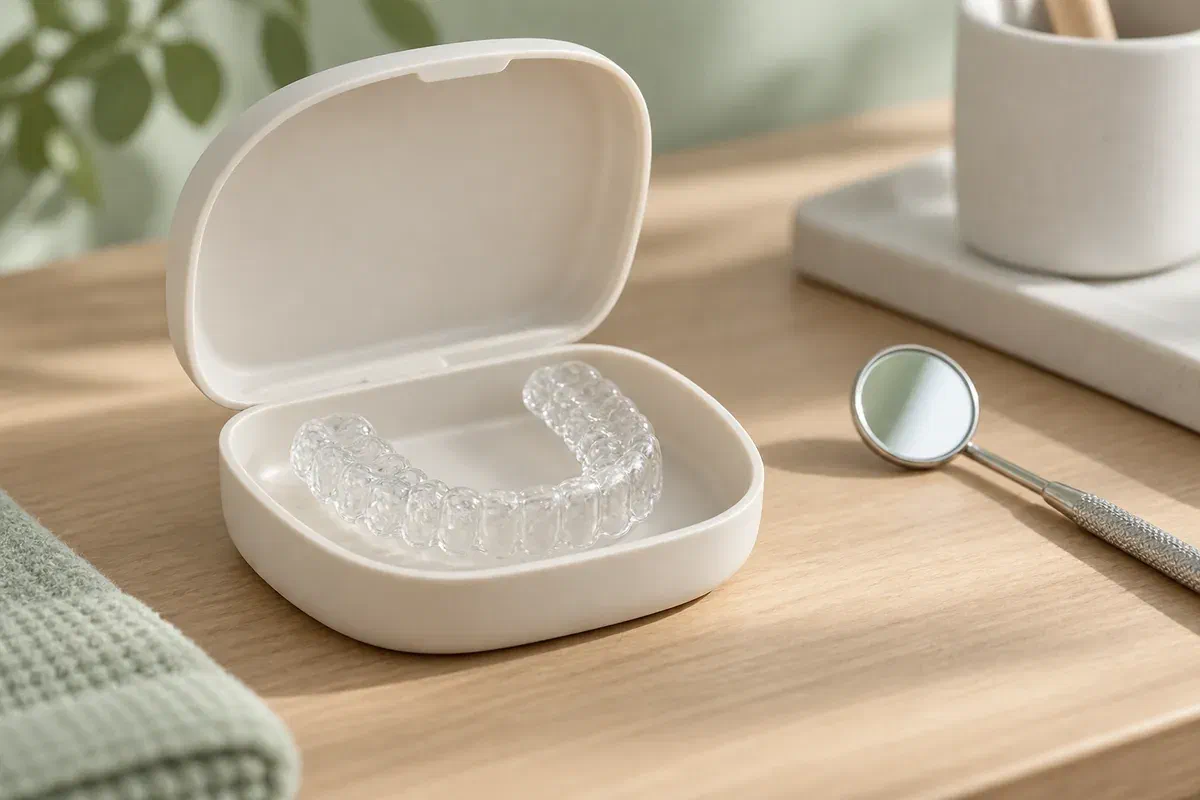
Illustrative single-arch clear dental nightguard in a protective case
Reasons to check

Signs that point toward a grinding review

Any one of these is enough to ask about. You do not need certainty that grinding is happening, or a record of every night, before booking.

Someone has heard grinding during sleep

Share what was heard and any other sleep concerns. That report adds to the history but cannot gauge tooth damage or settle the cause. Snoring, pauses in breathing or overwhelming daytime tiredness should be mentioned, since a medical evaluation may be the right step and no grinding guard addresses those.

Worn edges, chips or sensitive teeth

Explain when the change appeared, whether it hurts and whether chewing is affected. The dentist considers grinding along with other causes. If one tooth is sensitive on its own, it needs its own check rather than being assumed to be grinding-related.

A borrowed or makeshift appliance causing problems

Wearing a retainer or sports guard overnight to stop grinding can lead to soreness, a changed bite or a cracked device. Bring whatever you have been using. The appliance and your teeth are best assessed together, and damage alone does not mean a thicker device is the answer.

Call promptly if a tooth breaks, pain is severe, swelling develops or your jaw suddenly will not move normally. Those take priority over choosing an appliance.

The benefit of matching device to purpose

Each problem gets the tool designed for it.

Once the findings are clear, the plan can separate its parts. A fitted grinding guard may protect surfaces, a retainer may continue to hold tooth position, a damaged tooth may need repair and a jaw that aches may need its own approach. Asking which concern each device or step addresses keeps everything straight.

Progress is easier to judge when each appliance has a defined role. Comfort, whether you can wear the right device consistently and whether the teeth hold steady between visits all count for more than one quiet night or a few marks on the plastic.

Patient information: NIDCR — bruxism assessment and management

Confirm whether grinding is affecting the teeth

Previous records or photos can help the dentist see whether surfaces are changing. Other causes of wear are kept in view. Ask what will be monitored and what change would justify a device or treatment, rather than assuming every worn edge needs action.

Get a grinding guard that works with other appliances

If protection is advised, ask how the guard relates to any retainer you wear, how it should fit, when to use it and what it cannot do. It should be fitted and reviewed by a clinician. Where orthodontic retention matters, your orthodontist may need to be involved.

Consider other influences without blame

Sleep, medicines, stress and routines may all be relevant. Talking about them helps shape the plan without suggesting a single cause or that you have done something wrong. If the history points toward a medical question, we may suggest speaking with your physician.

At the appointment

Lay out the appliances, then look at the teeth.

Bring every device you use at night or for sport, with details of who provided them. The first visit clarifies what is needed, rather than assuming one appliance can do every job.

  1. Go through your appliances and history

    We discuss each device you use, why it was made, reports of grinding, when discomfort appears and changes to your teeth. Medicines, sleep and earlier treatment matter too. If you are not sure whether you grind at night, that uncertainty is part of what the examination considers.

  2. Examine teeth, jaw and the devices themselves

    The dentist checks wear, cracks, sensitivity and jaw tenderness, and looks at how each appliance fits. Some teeth may need further tests. You should hear what the findings support, and whether a borrowed device could be contributing to any discomfort.

  3. Assign each need its own solution

    That might mean monitoring, a dedicated grinding guard, keeping your retainer for retention, dental repair or a referral. Ask what each step should accomplish and its limits. Combining or improvising devices is not automatically a time saver.

  4. Review the arrangement over time

    Follow-up checks your teeth and every appliance in use. Get in touch sooner if something cracks, fits differently or hurts. If problems persist, the plan is reconsidered rather than swapping one device for another without addressing the original questions.

Keeping it all straight at home

One case, one purpose, one routine per appliance

A household with several appliances needs a simple system. What you are asked to do follows from your findings and the devices provided, and if guidance from your orthodontist and from us seems to conflict, ask both so the plan stays consistent.

Label and care for each device separately

Keep the grinding guard in its own case, clean it as shown and bring it to reviews. Avoid warming, bending or trimming it. Do not swap it with a retainer or sports guard. If it cracks, loosens or hurts, stop wearing it and call.

Ease daytime clenching

If you clench while awake, use the cues we agreed on and let your teeth part with the jaw relaxed. Avoid grinding deliberately to check worn spots. Tell us if a habit is hard to maintain so the advice can be adjusted.

Keep every provider informed

A fresh toothache, a night of noticeably worse sleep or a medicine that seems to coincide with heavier grinding are all worth a call. Medicine decisions stay with your prescriber, so please do not stop a prescription on your own. When an orthodontist, physician or sleep clinic is also involved, we can agree what each needs to hear so all the plans fit together.

Caledon care options

Monitor, protect, repair or refer

Ask what each reasonable choice involves, including watching for now. Nobody should present reshaping your teeth as a dependable way to stop grinding.

When wear is stable and symptoms are mild

Monitoring and practical habits

If the teeth show little change, you may not need a new device at all. Practical habits and a review date may be the right step. Ask what will be compared next time and what would change the plan.

When surfaces or restorations need protecting or fixing

A dedicated guard and targeted repair

A clinically fitted grinding guard, kept separate from any retainer, can help protect enamel overnight. A tooth that has already chipped or cracked is repaired as its own piece of work. Ask about each step's purpose and how it will be checked later. A successful repair does not prove the grinding has stopped.

When retention, sleep or other concerns are involved

Specialist or medical input

Orthodontic retention needs, sleep symptoms, persistent jaw pain or a medicine question may require input from another provider, such as your orthodontist or family doctor. Know what question the referral is meant to answer, and put a stronger appliance or any permanent bite change on hold until it does.

Patient information: NHS — when to seek review for teeth grinding

Appliance questions from Caledon

Retainers, sports guards and nightguards explained

Bring the devices you have and the questions they raise. These answers aim to separate the right tool from a makeshift substitute.

(905) 876-4488
Can I sleep in my hockey mouthguard to protect against grinding?
It is not designed for that. Sports guards are made to absorb impacts during play and may be bulky or poorly suited to overnight wear. Ask the dentist whether a grinding guard is needed and what type suits you.
Will wearing my retainer at night stop my teeth from wearing down?
A retainer is made to hold tooth position, not to withstand grinding forces, and it may crack or wear. If grinding is a concern, discuss it with both your dentist and orthodontist so retention and protection are planned together.
Can one appliance do the job of a retainer and a grinding guard?
Sometimes a design can address both, but that decision depends on your teeth and the providers involved. Do not assume any device can serve both purposes without a clinical assessment.
My partner's old nightguard fits me. Can I use it?
No. A fitted guard is made for one person’s teeth, and wearing someone else’s can cause soreness or bite problems, as well as hygiene concerns. Ask for your own assessment.
Does a sleep-apnea device also protect against grinding?
Not necessarily. Sleep-apnea appliances are prescribed after a medical diagnosis for breathing, and their effect on grinding varies. Tell both the dentist and physician about all your symptoms so the right devices are chosen.
Is a thicker guard always better if I grind heavily?
Not automatically. Thickness, material and fit should be chosen for your teeth and the purpose. A guard that is too bulky may be hard to wear. Ask why a particular design is recommended.
Book from Caledon

Bring the whole drawer of appliances.

Contact Milton Dental Clinic to have grinding assessed and to sort out which device, if any, suits your teeth. If a tooth has broken or you are in pain, tell us when you call so the timing can be decided.

Recommendations depend on the examination and may involve monitoring, a fitted guard, coordination with other providers, dental treatment or referral.

Visit Milton Dental Clinic
Unit 1, 342 Bronte St. S, Milton, ON L9T 5B7
Get directions Clinic hours
Monday–Thursday
11am–7pm
Friday–Sunday
By appointment only

Areas we serve

  • Milton
  • Oakville
  • Mississauga
  • Georgetown
  • Halton Hills
  • Acton
  • Campbellville
  • Brampton
  • Burlington
  • Puslinch
  • Rockwood
  • Erin
  • Caledon
  • Etobicoke
  • Old Milton
  • Bronte Meadows
  • Timberlea
  • Dorset Park
  • Dempsey
  • Clarke
  • Beaty
  • Coates
  • Harrison
  • Scott
  • Willmott
  • Ford
  • Bowes
  • Cobden
  • Walker
  • Mountain View
  • Milton Heights
  • Hawthorne Village
  • Valley View
  • Fallingbrook
  • Nassagaweya
  • Trafalgar
  • Esquesing
  • Nelson
  • Brookville
  • Moffat
  • Glen Williams
  • Norval
  • Limehouse
  • Stewarttown
  • Ashgrove
  • Hornby
  • Silver Creek
  • Speyside
  • Scotch Block
  • North Oakville
  • River Oaks
  • Glen Abbey
  • West Oak Trails
  • Palermo
  • Bronte Creek
  • College Park
  • Joshua Creek
  • Uptown Core
  • Preserve
  • Iroquois Ridge
  • Lisgar
  • Meadowvale
  • Meadowvale Village
  • Churchill Meadows
  • Erin Mills
  • Central Erin Mills
  • Streetsville
  • East Credit
  • Creditview
  • Heartland
  • Sheridan
  • Mount Pleasant
  • Credit Valley
  • Huttonville
  • Churchville
  • Springbrook
  • Northwest Brampton
  • Bram West
  • Fletcher's Meadow
  • Fletcher's Creek South
  • Alton Village
  • Orchard
  • Millcroft
  • Headon Forest
  • Tansley
  • Brant Hills
  • Tyandaga
  • Kilbride
  • Lowville
  • Aberfoyle
  • Morriston
  • Arkell
  • Hillsburgh
  • Freelton
  • Carlisle
  • Waterdown
  • Flamborough
  • Mountsberg

How can we help?

Milton Dental Clinic

Have a question about your smile? Choose the option that works best for you.

For urgent dental concerns, please call.
Messages are reviewed during clinic hours.