
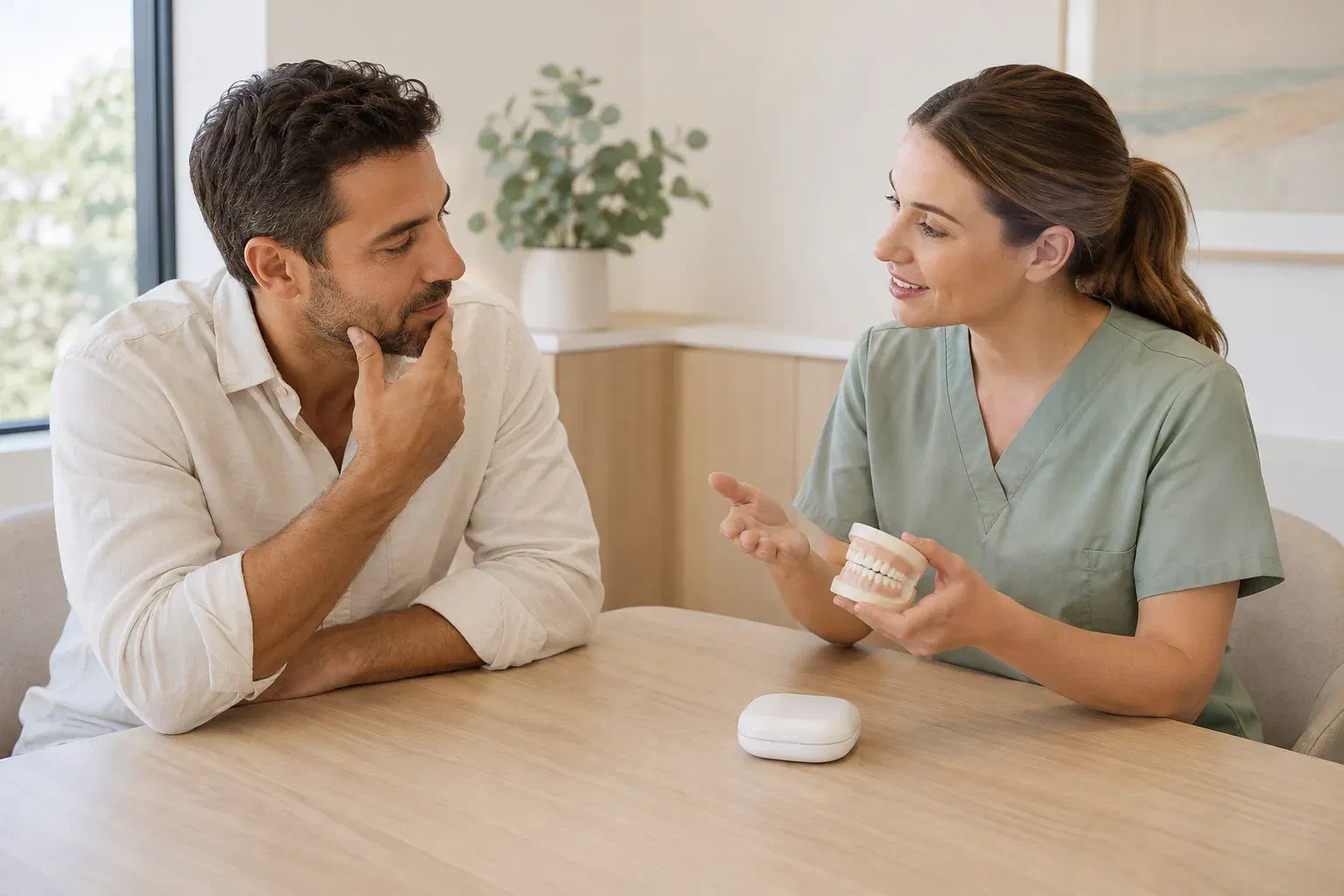
Illustrative consultation about teeth grinding and possible tooth wear
Specialized Care

Teeth-Grinding Treatment in Oakville

Standing in a store aisle holding a boil-and-bite guard is a common first move when grinding is suspected. If you are coming from Oakville, a dental assessment first can show whether protection is needed, what kind suits your teeth, and what else deserves attention.

From Oakville, before you buy a guard

Buy one now, or get checked first?

A ready-made guard is inexpensive and easy to find, so it is tempting to try one the moment grinding comes up. The trouble is that nobody has yet looked at why your teeth are wearing or whether they need shielding at all. Grinding and clenching, grouped by dentists as bruxism, can happen during sleep or in waking hours, and the right response depends on the person.

An examination gives the purchase some context. Plenty of tooth wear has nothing to do with grinding, and a surface that flattened years ago does not tell anyone how much is happening now. The dentist combines your history, today's symptoms and the clinical findings before talking about monitoring, protection, repair or a further assessment.

If you have already tried a store-bought or fitted guard, tell us how it went and bring it with you. We would rather see it than hear it described. Together we can set a plan with a stated aim, perhaps protecting a vulnerable surface or investigating a symptom that will not settle, while being honest that no device permanently stops grinding.

Get grinding checked before choosing a guard
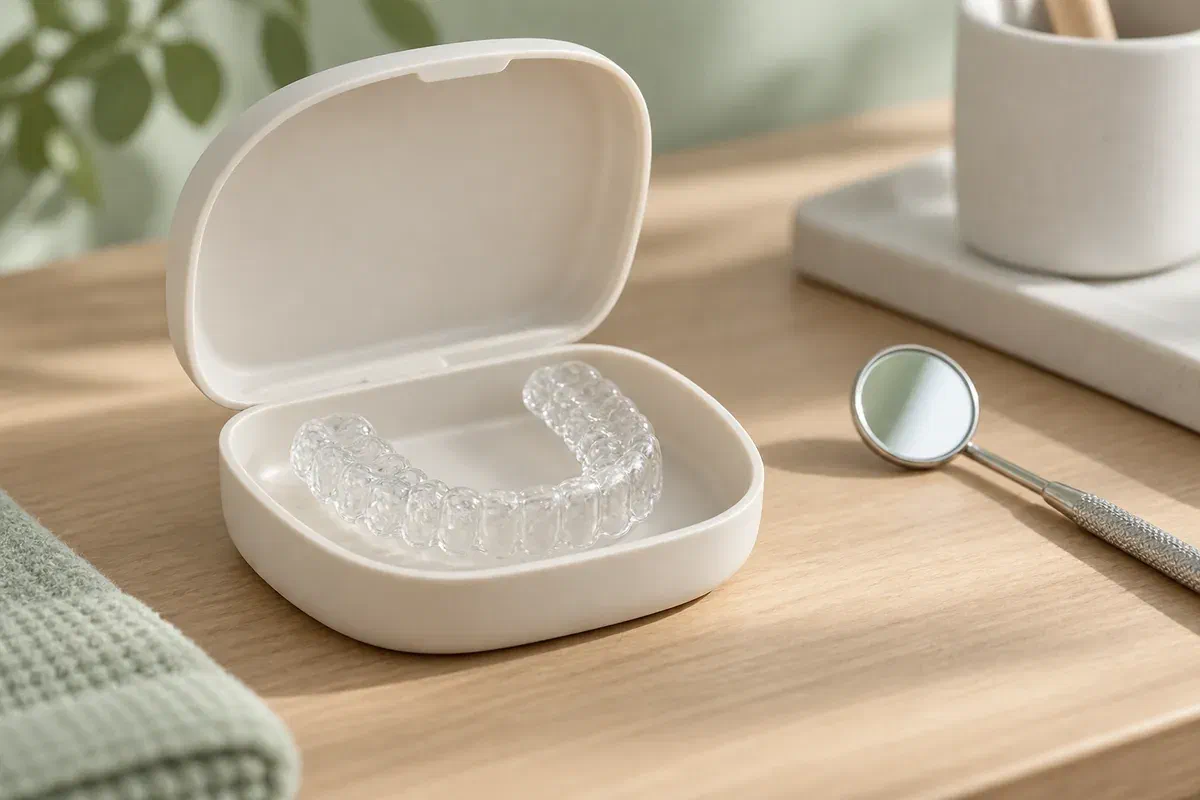
Illustrative single-arch clear dental nightguard in a protective case
Clues that bring people in

What made you reach for a guard?

The answer is a good place to start. A few clear observations are enough; nobody needs a recording of every night or certainty that grinding is the cause.

Someone heard grinding while you slept

Let us know what was heard and whether sleep itself has been a problem. That report helps, but it cannot show how much damage exists or name every cause. Snoring, pauses in breathing and unusual daytime sleepiness are worth mentioning so a medical opinion can be discussed when it fits.

A chip, a sore spot or edges that look shorter

Say whether it is new, painful or making eating harder. The dentist considers that tooth's condition and the other ways enamel can wear. Sensitivity in one tooth can have its own cause, so it is worth checking rather than assuming it is simply a side effect of grinding.

A guard that broke or never felt right

Bring the guard that cracked, wore thin or felt bulky, along with the story of any fillings or crowns that keep failing. Reviewing both together is more useful than either alone. A broken device does not automatically call for a sturdier one or another restoration; the findings guide the choice.

Choosing a guard can wait. A cracked or broken tooth, strong pain, any swelling, or a jaw that suddenly will not open or close normally cannot, so call us promptly about those.

The value of an assessment first

You end up with protection that has a reason behind it.

A store guard tries to do one thing for everyone. A considered plan separates the jobs: a fitted appliance might protect teeth, a cracked tooth might need repair, and a persistent jaw ache might need its own evaluation. Knowing which finding each step addresses explains why more than one may be suggested.

It also gives you a way to tell whether the plan is working. Comfort, whether you can wear the appliance through the night, and how the teeth change over time all count. Those observations are more informative than a single night of quiet or a few marks on the plastic.

Patient information: NIDCR — bruxism assessment and management

Find out whether wear is active and what drives it

Photographs from a few years back, or charts from a previous dentist, can show whether surfaces have moved since. Other parts of your history matter too, because grinding is only one way enamel thins. Ask which teeth are being tracked and what would tip the balance toward treatment; a worn tooth rarely needs a crown the same week.

Choose a device suited to your teeth and the purpose

Where protection makes sense, a clinically fitted guard is shaped to your bite and checked again if it rubs or loosens. You should leave knowing its purpose, its limits and your wearing schedule. Sports mouthguards, orthodontic retainers and sleep-apnea appliances are each designed for something else, so one cannot quietly take over another's role.

Talk about other influences without blame

Stress, sleep, daily routines and medicines sometimes enter the discussion. Raising them is about understanding, not fault-finding, and rarely leads to one tidy explanation. Should something in your history belong with your physician or another clinician, we will say so and suggest how the two sides can stay coordinated.

How the appointment unfolds

Four steps from first question to follow-up

Bring any guard you have bought or been given and tell us what it did or did not do. The first visit is about clear findings and options, not a one-size routine.

  1. Share the story behind your concern

    Start wherever makes sense to you: the guard you bought, the sound a partner described, a morning headache, a chipped filling. We will also ask about medicines, sleep and past dental care. Plenty of people have no idea whether they grind overnight, and that is a legitimate answer the examination can work around.

  2. Examine the teeth, dental work and sore areas

    The dentist checks for wear, fractures, sensitivity and tenderness in the jaw. A particular tooth may need more tests, and previous records may show whether anything has changed. Ask what the findings support and whether another explanation exists before agreeing to a device or restoration.

  3. Line up the options side by side

    Sometimes the honest conclusion is that nothing needs doing yet. Other times a fitted guard, a repair or a second opinion earns its place. For each choice, ask what it is supposed to change and where it falls short; more treatment does not mean better treatment.

  4. Review how it is going

    Agree on a follow-up and the changes that should bring you back sooner. If you receive an appliance, its comfort and condition are checked with your teeth. Persistent symptoms or repeated damage call for a new assessment, not a run of replacement guards that leaves the underlying questions unasked.

Living with the plan

Small habits matter, and so does reporting what changes.

What you are asked to do at home follows from your own findings and whatever device or dental work was provided. When our advice and a guard's packaging disagree, follow ours and ask why the difference exists.

Care for a fitted guard the way you were shown

Follow the cleaning and storage instructions and bring it to each review. Do not boil, bend, cut or reshape it at home, even if a store guard you used before allowed that. Call about a looser fit, cracks or pain, and stop using a broken appliance rather than pushing through discomfort.

Notice daytime clenching without checking constantly

Daytime clenching tends to show up during concentration, driving or screen time. A small cue, such as lips together and teeth apart, can help you catch it. Running your teeth over rough spots to test them only adds pressure. Mention it if the cue is not working so we can try something different.

Connect your dental and medical care

Report new tooth symptoms, sleep changes or a possible link with a medicine change. Do not stop a prescription by yourself. Where another clinician is involved, ask what information should be shared so dental care and your broader health assessment move together.

Comparing approaches

Monitor, shield, repair, or look further.

Every route, including waiting and watching, should come with an explanation of what it involves. Be wary of any suggestion that reshaping your teeth will make the grinding go away.

When the findings suggest starting conservatively

Monitoring and everyday strategies

Mild, stable wear with few symptoms may need nothing more than a few practical habits and a date to look again. That is a real plan, not a brush-off. Find out which surfaces or symptoms are being followed, and what kind of change would move things toward a guard or repair.

When surfaces or restorations need protection or repair

A fitted guard and care for specific teeth

A clinically fitted guard may help protect teeth, while a damaged tooth may need its own treatment. Talk through each step's purpose, limits and follow-up. Repairing worn teeth does not prove grinding has stopped or that other teeth can go unwatched.

When the history or response points to more assessment

Further evaluation for unanswered questions

A jaw that keeps aching, one tooth that never settles, signs of disrupted sleep or a question about a medication can each justify another opinion, dental or medical. Find out what that referral is meant to answer. Until it does, a heavier guard or permanent bite adjustment is premature.

Patient information: NHS — when to seek review for teeth grinding

Questions about guards and grinding

What a guard can do, and what it cannot

Bring whatever prompted your concern, even if it is occasional. The goal is to separate sensible protection from promises no device can keep.

(905) 876-4488
How is a fitted guard different from a boil-and-bite one?
One is shaped at home by softening plastic and biting into it; the other is made for your teeth after an examination and checked at later visits. Before choosing either, it helps to know whether your teeth need protecting in the first place.
Is it harmful to keep using a store-bought guard while I wait for an appointment?
Stop if it causes pain, changes how your bite feels or has cracked. Otherwise, bring it to the visit so the dentist can see how it fits and how it has worn, and ask whether continuing makes sense.
Can grinding happen even when nobody hears it?
Yes. Clenching can be silent, and many people sleep alone or are not overheard. That is why the dentist looks at symptoms, history and the teeth rather than relying on whether anyone reports noise.
Does an old flat edge prove I grind every night?
No. Wear records what has happened to a surface over time and does not measure current activity. Comparing findings across visits or with earlier records can show whether change is ongoing.
Will wearing a guard make me grind less?
Possibly not. Its main role is to take the wear in place of your enamel, and some people grind just as much with one in. Judge it by how your teeth and jaw fare over months, which is what reviews are for.
Should I mention snoring during a grinding appointment?
Yes. Snoring, breathing pauses or heavy daytime tiredness may warrant a medical evaluation. Grinding does not by itself mean sleep apnea, and a grinding guard is not a replacement for a sleep assessment or prescribed treatment.
Grinding care for Oakville adults

Hold off on the store guard and bring your questions in.

Coming from Oakville, it is worth one visit to Milton Dental Clinic before spending money on a guard that may not suit you. Tell us about any pain or a fresh break so an earlier slot can be considered.

You might leave with a watch-and-wait plan, a fitted guard, a repair or a referral; which one depends on what we find.

Visit Milton Dental Clinic
Unit 1, 342 Bronte St. S, Milton, ON L9T 5B7
Get directions Clinic hours
Monday–Thursday
11am–7pm
Friday–Sunday
By appointment only

Areas we serve

  • Milton
  • Oakville
  • Mississauga
  • Georgetown
  • Halton Hills
  • Acton
  • Campbellville
  • Brampton
  • Burlington
  • Puslinch
  • Rockwood
  • Erin
  • Caledon
  • Etobicoke
  • Old Milton
  • Bronte Meadows
  • Timberlea
  • Dorset Park
  • Dempsey
  • Clarke
  • Beaty
  • Coates
  • Harrison
  • Scott
  • Willmott
  • Ford
  • Bowes
  • Cobden
  • Walker
  • Mountain View
  • Milton Heights
  • Hawthorne Village
  • Valley View
  • Fallingbrook
  • Nassagaweya
  • Trafalgar
  • Esquesing
  • Nelson
  • Brookville
  • Moffat
  • Glen Williams
  • Norval
  • Limehouse
  • Stewarttown
  • Ashgrove
  • Hornby
  • Silver Creek
  • Speyside
  • Scotch Block
  • North Oakville
  • River Oaks
  • Glen Abbey
  • West Oak Trails
  • Palermo
  • Bronte Creek
  • College Park
  • Joshua Creek
  • Uptown Core
  • Preserve
  • Iroquois Ridge
  • Lisgar
  • Meadowvale
  • Meadowvale Village
  • Churchill Meadows
  • Erin Mills
  • Central Erin Mills
  • Streetsville
  • East Credit
  • Creditview
  • Heartland
  • Sheridan
  • Mount Pleasant
  • Credit Valley
  • Huttonville
  • Churchville
  • Springbrook
  • Northwest Brampton
  • Bram West
  • Fletcher's Meadow
  • Fletcher's Creek South
  • Alton Village
  • Orchard
  • Millcroft
  • Headon Forest
  • Tansley
  • Brant Hills
  • Tyandaga
  • Kilbride
  • Lowville
  • Aberfoyle
  • Morriston
  • Arkell
  • Hillsburgh
  • Freelton
  • Carlisle
  • Waterdown
  • Flamborough
  • Mountsberg

How can we help?

Milton Dental Clinic

Have a question about your smile? Choose the option that works best for you.

For urgent dental concerns, please call.
Messages are reviewed during clinic hours.