
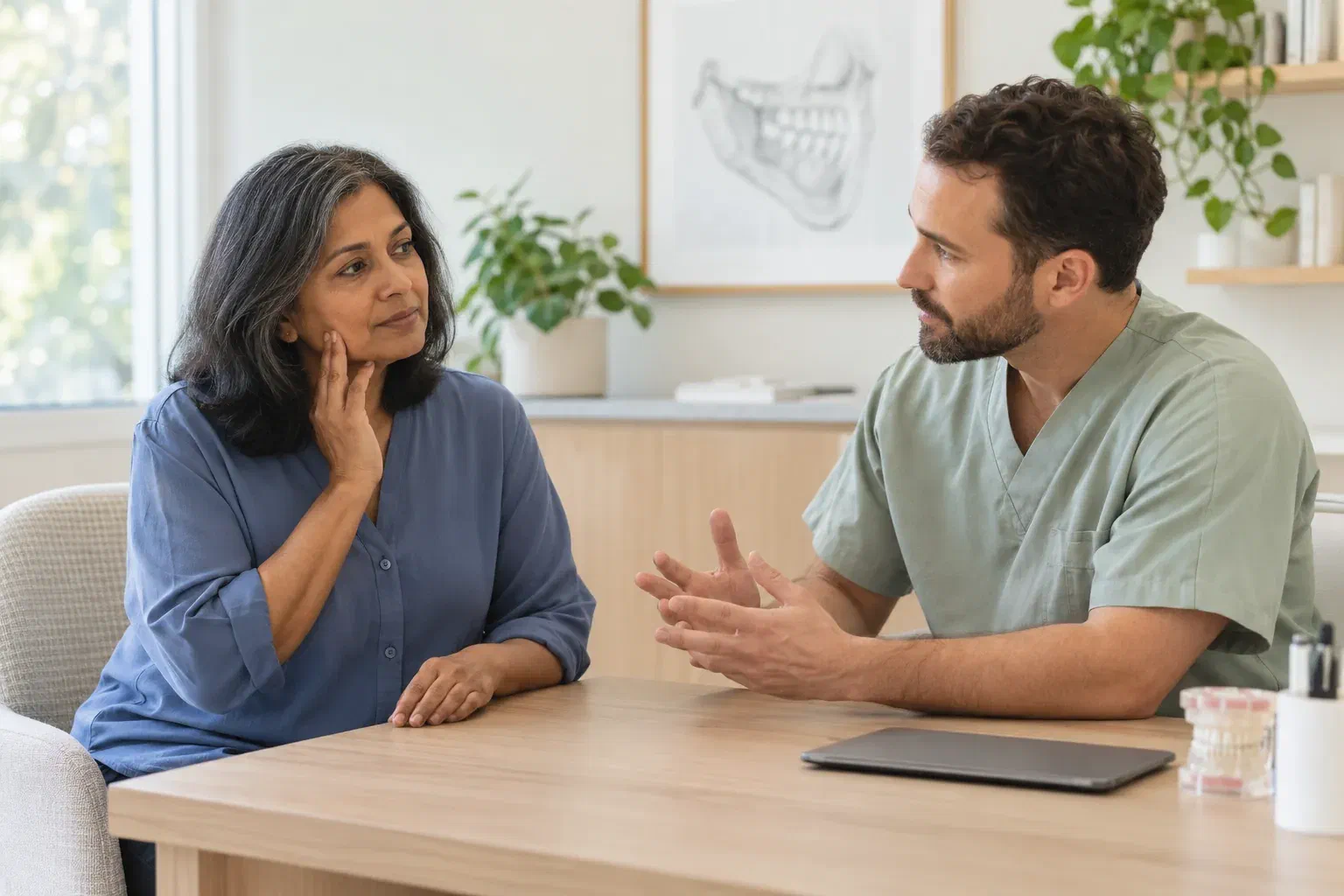

Illustrative discussion of jaw symptoms and conservative TMD care
Specialized Care

TMD Treatment in Etobicoke

A longer trip means each TMD appointment should earn its place. For people in Etobicoke, we prepare ahead, use the visit to examine the jaw and teeth thoroughly, and leave you with a clear home plan and advice on when nearer urgent care makes sense.

Making a longer journey worthwhile

What should one well-organised visit accomplish?

Coming from the west end of Toronto, you probably do not want a string of short appointments that each answer one small question. A better approach is to do the groundwork before you arrive: gather records, bring any appliance, and jot down when the jaw hurts and what it stops you doing. Then the time in the chair can go further.

Jaw pain, stiffness and painful clicking often fall under temporomandibular disorders, a broad term for problems with the jaw joints and chewing muscles. It is not a single condition, and it is not the only explanation for pain in that area. A tooth that needs care, a facial injury or a medical concern may be involved, and those should be identified rather than assumed away.

For an Etobicoke household, our aim is a first visit that covers your history and a careful examination, explains what we found and what we still do not know, and ends with a practical plan you can carry out at home. You will also know which changes call for a phone call, and which warrant urgent care closer to where you live.

Plan a well-prepared TMD visit
Illustrative wrapped comfort pack and notebook for a home-care discussion
Prepare before you travel

Write down three things: what hurts, what sticks, what you have tried.

A short list gathered over a few days helps us use your appointment well. Please avoid repeatedly triggering the pain to check it; noticing and noting is enough.

Pain that limits eating, talking or daily tasks

Note the location, the time of day and the activities that set it off, and whether rest takes the edge off. That record shapes the examination. We still consider teeth, sinuses and medical causes, since jaw-area discomfort does not automatically mean a temporomandibular disorder.

Catching, locking or reduced opening

Record what happens and whether the jaw releases by itself. Do not force it or attempt to work it back into place. If you abruptly cannot open or close, particularly after a blow or fall, seek prompt care; when that happens far from our office, nearer urgent services may be the right first stop.

Painful clicking, or treatment that has not worked

Note clicking that comes with pain or restriction, and pack any guard or splint you have used. List exercises, medicines and procedures you have tried, with what each changed. A painless click that does not limit movement is usually not something that needs treating.

If you cannot eat or drink, have marked swelling, a fever or new symptoms after trauma, get urgent advice without waiting for a planned trip. Breathing difficulty or a serious medical emergency needs emergency care where you are.

Leaving with a plan, not a puzzle

Every step should have a reason and a review date.

When follow-up means another long drive, it matters even more that the plan is clear on day one. Decide together what you want to improve, perhaps comfortable chewing, fewer flares, or a habit you would like to break. Every suggestion can then be checked against that aim, and you will know how and when it will be reviewed.

Conservative measures are a common and reasonable start, but they need to be specific enough to follow without the clinician beside you. You should leave knowing what to do, why, and when to check in. If a step is not helping or symptoms shift, getting in touch is expected, and we can talk about whether that needs an in-person visit.

Patient information: NIDCR — TMD assessment and conservative treatment principles

A working explanation you can take home

We explain which findings point toward muscle, joint or another source, and whether more assessment is needed. Some questions are only answered by watching change over time or involving another provider. A careful explanation, with its uncertainties stated, is more use than a label.

Measures you can manage without frequent visits

Self-care, movement guidance and other conservative options are chosen to suit your findings and to be manageable from home. Ask what to do if a measure increases pain. The plan should adjust to how you respond rather than leaving you to persist with something intolerable.

Considered decisions about appliances or referral

If an appliance, referral or procedure is suggested, ask about its aim, the evidence, alternatives and limits. A device to protect teeth is a different thing from one meant to reduce pain. No option should be presented as a guaranteed cure, and a referral closer to home may sometimes be sensible.

How we organise the appointment

Groundwork first, so the visit can go deeper.

Send or bring earlier records, imaging reports and any appliance. Tell us what matters most and whether prolonged opening or reclining is uncomfortable, so we can plan breaks.

  1. Review your notes and history together

    Onset, changes, triggers, injuries, health conditions, sleep, medicines and past treatment are all part of the conversation. Coming prepared means we can quickly see which questions remain open, instead of repeating ground or adopting another provider’s suggestion without checking it.

  2. Carry out a thorough examination

    We may assess your teeth, jaw movement, the joints and the chewing muscles in the same visit, with imaging or tests considered when they would answer a clinical question. Tell us when a movement brings on the pain you recognise, and stop short of forcing.

  3. Set out a home plan and what to watch for

    We share the findings and agree on a proportionate approach, usually conservative. You go home with written-down instructions, clear advice on any appliance or medicine, and a list of warning signs. If another provider is needed, we explain the referral question and what to do meanwhile.

  4. Plan the review to suit the distance

    We agree when to reassess and what to report before then. At review, we look at what you used and what changed; limited progress may mean adjusting the plan, revisiting the diagnosis or further assessment, rather than adding treatment because a set period has passed.

Managing at home

Clear instructions travel better than vague ones.

Rely on the guidance made for your examination. Generic videos, a borrowed splint or online alignment claims should not override advice written for your own symptoms.

Take pressure off the jaw during flares

Ask about softer textures for a while and about limiting gum chewing or clenching if they seem to aggravate things. Find out how to work back to your normal diet. Try not to test the jaw constantly, while still moving it in ordinary ways.

Apply comfort and exercise advice exactly as shown

If warmth, cool packs, massage or exercises are suggested, confirm the technique, duration and stopping signs before you leave. Keep heat or ice off bare skin and do not push through pain. Medicine advice should reflect your health and other treatments.

Phone first if an appliance hurts or symptoms change

Stop wearing a prescribed appliance that causes pain and call the provider rather than adjusting it yourself. Report new locking, reduced opening or other clear changes. Keep the agreed review even when symptoms fluctuate, so the plan is judged over a fair stretch of time.

Choosing between options

Least disruptive first, with a clear purpose for anything more

Ask which approaches suit your findings and what remains uncertain. Reshaping teeth or altering the bite permanently is not an established cure for TMD, and pain that persists does not by itself justify surgery.

A practical, non-invasive start

Supported conservative management

Habit advice, comfortable jaw use, a temporary softer diet, relaxation and guided movement are well suited to doing at home. We set a review point that makes sense for your travel. If the response is limited, we reconsider rather than simply repeating the same advice.

When a particular finding supports it

An appliance or other specific measure

An appliance may be suggested for a defined purpose, but benefit for TMD pain is not assured. Ask about design, limitations and how often it needs checking, which matters when visits involve a long trip. Be wary of devices meant to permanently alter your bite without a clear rationale.

When further expertise would help

Specialist input or shared care

Physiotherapy, medical care or a dental specialist may address some concerns, and a provider nearer home can be considered. Find out what question the referral asks and how results will be shared. Invasive procedures belong to carefully assessed cases, discussed with their risks and alternatives.

Planning TMD care from a distance

Questions about organising your visits

Jaw problems differ, and so do the visits they need. Understanding your findings, and how to manage between appointments, matters more than any fixed routine.

(905) 876-4488
Can I send my records before the appointment?
Yes. Earlier imaging reports, notes from other providers and a list of past treatments are useful in advance. Bring any appliance on the day so we can look at it during the examination.
What jaw symptoms mean I should not wait for my booked visit?
Being unable to eat or drink, significant swelling, fever, sudden locking or new symptoms after an injury all need prompt attention. Breathing difficulty is an emergency. In those situations, nearer urgent care may be the fastest option.
How many appointments does TMD care usually involve?
It varies with your findings and how you respond. Many people have an assessment followed by one or more reviews. We aim to keep visits purposeful, and to explain what each one is for.
Should I keep using a splint another dentist made for me?
Bring it so we can check its fit and purpose. If it causes pain, stop wearing it. Whether it still has a role depends on your current findings.
Is it worth the trip from Etobicoke for a jaw assessment?
That is your decision. If you choose to come, we will make the first visit as complete as is sensible, and we can discuss whether any follow-up care or referral could reasonably happen closer to home.
If my jaw does not improve, will I need surgery?
Not necessarily. A lack of improvement calls for a review of the findings and earlier care, and many next steps remain conservative or involve another opinion. Surgery is considered only in selected cases, after discussing reasons, alternatives and risks.
Book from Etobicoke

Bring your notes and make the visit count.

Get in touch with Milton Dental Clinic to arrange a TMD assessment. Send or bring records, pack any appliance and tell us how your jaw affects daily life, so we can plan an appointment that covers what matters in one well-used visit.

Care is individualized and may involve conservative measures, review or referral.

Visit Milton Dental Clinic
Unit 1, 342 Bronte St. S, Milton, ON L9T 5B7
Get directions Clinic hours
Monday–Thursday
11am–7pm
Friday–Sunday
By appointment only

Areas we serve

  • Milton
  • Oakville
  • Mississauga
  • Georgetown
  • Halton Hills
  • Acton
  • Campbellville
  • Brampton
  • Burlington
  • Puslinch
  • Rockwood
  • Erin
  • Caledon
  • Etobicoke
  • Old Milton
  • Bronte Meadows
  • Timberlea
  • Dorset Park
  • Dempsey
  • Clarke
  • Beaty
  • Coates
  • Harrison
  • Scott
  • Willmott
  • Ford
  • Bowes
  • Cobden
  • Walker
  • Mountain View
  • Milton Heights
  • Hawthorne Village
  • Valley View
  • Fallingbrook
  • Nassagaweya
  • Trafalgar
  • Esquesing
  • Nelson
  • Brookville
  • Moffat
  • Glen Williams
  • Norval
  • Limehouse
  • Stewarttown
  • Ashgrove
  • Hornby
  • Silver Creek
  • Speyside
  • Scotch Block
  • North Oakville
  • River Oaks
  • Glen Abbey
  • West Oak Trails
  • Palermo
  • Bronte Creek
  • College Park
  • Joshua Creek
  • Uptown Core
  • Preserve
  • Iroquois Ridge
  • Lisgar
  • Meadowvale
  • Meadowvale Village
  • Churchill Meadows
  • Erin Mills
  • Central Erin Mills
  • Streetsville
  • East Credit
  • Creditview
  • Heartland
  • Sheridan
  • Mount Pleasant
  • Credit Valley
  • Huttonville
  • Churchville
  • Springbrook
  • Northwest Brampton
  • Bram West
  • Fletcher's Meadow
  • Fletcher's Creek South
  • Alton Village
  • Orchard
  • Millcroft
  • Headon Forest
  • Tansley
  • Brant Hills
  • Tyandaga
  • Kilbride
  • Lowville
  • Aberfoyle
  • Morriston
  • Arkell
  • Hillsburgh
  • Freelton
  • Carlisle
  • Waterdown
  • Flamborough
  • Mountsberg

How can we help?

Milton Dental Clinic

Have a question about your smile? Choose the option that works best for you.

For urgent dental concerns, please call.
Messages are reviewed during clinic hours.