
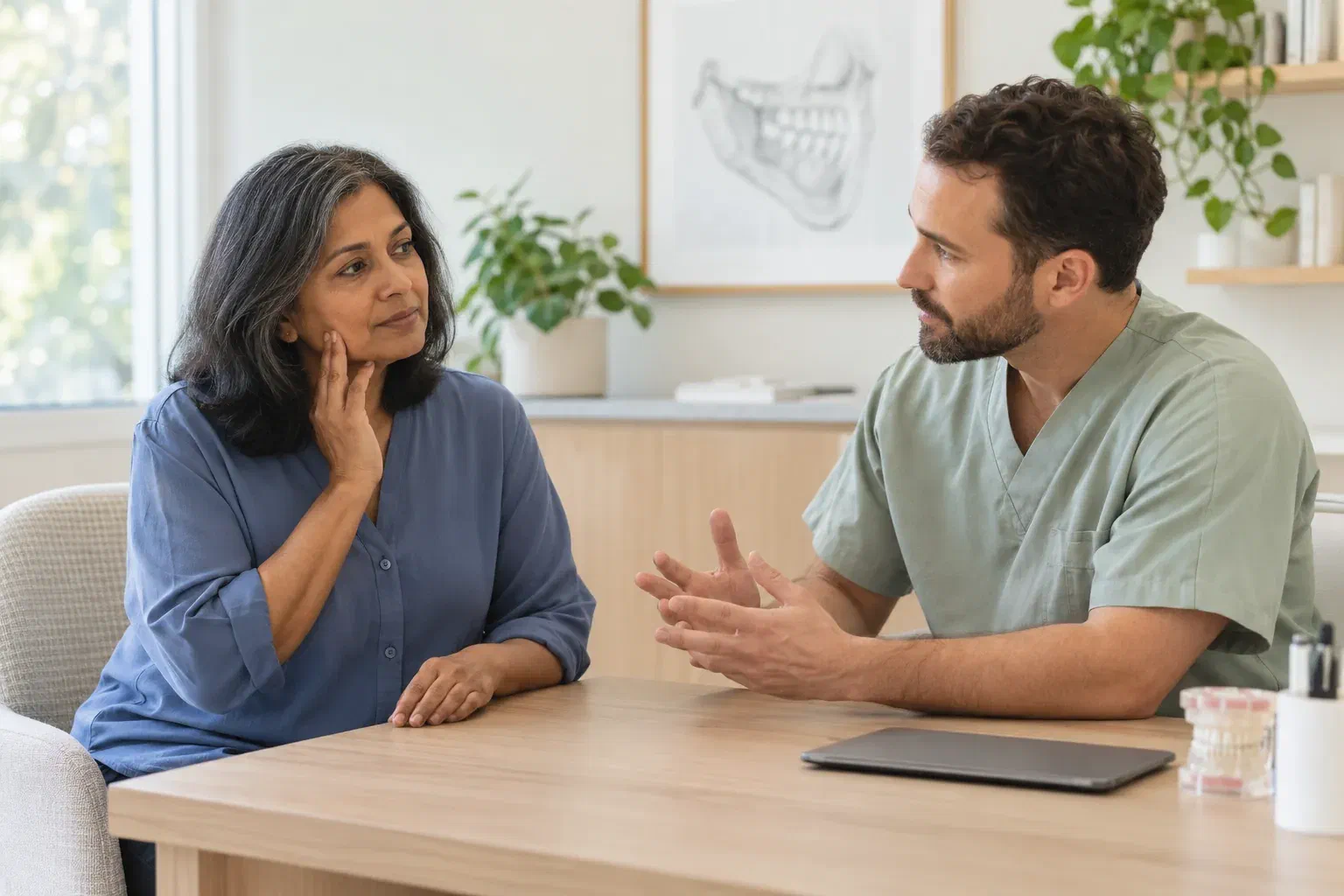

Illustrative discussion of jaw symptoms and conservative TMD care
Specialized Care

TMD Treatment in Georgetown

Cutting food smaller, chewing on one side, skipping the crusty bread. Those quiet changes often mean the jaw needs a closer look. From Georgetown, book an assessment of your teeth, jaw joints and muscles, followed by conservative TMD care with clear review points.

Small changes at the table

Chewing on one side

Nobody decides to stop eating bagels. It just happens: one painful bite, then a habit of tearing them up, then a quiet switch to softer food. Many people adapt like this for months before mentioning it. Those workarounds are worth bringing up, because they show how much the jaw is affecting daily life.

Pain when chewing can come from several places. A cracked tooth, a sore gum, a new filling that sits slightly high or an infection may be the cause. So may temporomandibular disorders, a family of conditions affecting the joint in front of each ear and the muscles that power chewing. An examination helps tell these apart, so the right problem gets treated.

For people coming down from Georgetown, the appointment starts with your eating habits, along with speaking, sleep and work. We examine the teeth and jaw, explain what we found and what is still uncertain, and suggest a proportionate first step. Often that means simple measures at home with a review, and sometimes a referral.

Book a look at chewing pain and jaw symptoms
Illustrative wrapped comfort pack and notebook for a home-care discussion
Clues from mealtimes

Which foods have you quietly given up?

A list of foods you now avoid, and why, can tell us a lot. You do not need to bite into something hard before your visit to confirm the pain; we would rather you did not.

Soreness that changes what or how you eat

Show us where it hurts and say which foods or bite sizes trigger it. Is it sharp at one tooth or a dull ache through the cheek? Does it fade after the meal? A sharp, localized pain may point toward a tooth, so we examine teeth as well as the jaw before naming TMD.

Opening that feels short of a full bite, or a catch

Mention if a sandwich or apple no longer fits comfortably, or if the jaw catches while chewing. Please do not stretch it wider to check, or try to force it back into place. If opening or closing suddenly becomes blocked, especially after a fall or knock, get prompt advice.

Noises during chewing, or approaches that have not worked

Describe any clicking or grating that hurts or comes with restriction. Tell us about guards, exercises, medicines or dental work you have already had and what changed afterwards. A click that does not hurt and never limits movement is a different situation and usually needs no treatment.

Get urgent advice if you are unable to eat or drink, notice significant swelling or fever, or have new problems after an injury. Difficulty breathing or any serious medical emergency needs emergency care immediately.

Getting back to normal meals

What would you like to eat again?

Goals do not need to be grand. Biting into a burger, enjoying a family meal without cutting everything into cubes, or chewing evenly on both sides again are all reasonable targets. Once a goal is agreed, it becomes easier to ask how each recommendation helps and how you will notice progress.

For many people, conservative care is the natural starting point, but it should be specific to your findings and properly followed up. You should understand each step, the reason for it and when it will be reviewed. If a measure does not help, or your symptoms change, coming back to talk it through is simply part of care.

Patient information: NIDCR — TMD assessment and conservative treatment principles

A clear view of the likely source

We explain whether the findings lean toward a tooth, the chewing muscles, the joint or something else, and whether more information is needed. Sometimes a pattern has to be followed for a while, or another provider asked. A careful working answer usually beats a fast label.

Food and habit changes that can be adjusted

Temporary diet changes, habit advice and other conservative steps are chosen to suit what we found and how you like to eat. Ask what to do if a change makes things worse. The plan should flex in response to your experience, rather than asking you to stick with soft food forever.

Full information before more involved care

If an appliance, referral or procedure is mentioned, ask about its purpose, supporting evidence, alternatives and limits. Repairing a broken tooth, protecting enamel from wear and easing jaw pain are separate aims. No option should be described as certain to cure TMD.

What to expect

We check the teeth and the jaw, not one or the other.

Bring past records, details of any recent dental work and any appliance you wear. Say what matters most, and let us know if sitting back with your mouth open is uncomfortable so we can plan rests.

  1. Talk about eating, history and health

    We cover when the problem started, which foods are hard, how things have changed, injuries, health conditions, sleep, medicines and earlier care. Recent fillings or crowns are worth mentioning. That helps us see what still needs answering before accepting an older recommendation.

  2. Examine teeth, bite, joints and muscles

    The examination may include individual teeth, how they meet, how the jaw opens and moves, the joints and the chewing muscles. Imaging or tests are used when they would answer a real question. Let us know when your usual pain appears, and stay within comfort.

  3. Agree on a starting plan

    We explain what we found and agree on a proportionate approach, which may be dental treatment for a tooth, conservative jaw care or both. You leave with clear instructions and advice about any appliance or medicine. If a referral is needed, we explain why.

  4. Review how eating has changed

    At follow-up we discuss which steps you used and whether meals feel easier. Limited progress may mean adjusting the plan, reconsidering the diagnosis or arranging further assessment. Next steps follow your response, not a schedule that adds treatment by default.

Back home in Georgetown

Easier food for a while, then a steady return

Use the advice given for your own examination. Online diet lists for TMD, a borrowed guard or claims about realigning the jaw should not outweigh guidance made for your symptoms.

Choose textures that give the jaw a break

During a flare, smaller bites and softer textures may make meals more comfortable, and cutting back on gum or chewy snacks can help some people. Ask how and when to bring firmer foods back. Avoid very wide bites, but there is no need to stop using your jaw.

Use comfort measures as you were shown

If warm compresses, cold packs, gentle massage or exercises were recommended, make sure you know how, how long and when to stop. Keep a cloth between skin and heat or ice, and do not force a sore movement. Medicine advice should fit your health and other medications.

Tell us about bite changes or a painful appliance

If your bite suddenly feels different, a new filling feels high or a prescribed appliance hurts, contact us rather than adjusting anything yourself. Report new catching or reduced opening too. Keep the agreed review even if meals have good and bad days.

What might help

Treat the tooth if it is the tooth, and the jaw if it is the jaw.

Ask which options make sense for what we found and what is uncertain. Grinding or rebuilding teeth to change the bite is not a reliable way to treat TMD, and pain that continues does not by itself point to surgery.

When non-invasive care is the right start

Supported conservative management

This may involve temporary food changes, habit advice, relaxation, comfortable jaw use and clinician-guided movement. It should fit how you eat and live, with a review point. If you are not improving, we reassess the plan rather than repeating the same suggestions.

When a specific finding supports it

An appliance or another targeted treatment

An appliance may have a role for a particular reason, though relief of TMD pain is not guaranteed. Ask about its design, limits and follow-up, and avoid devices meant to permanently change your bite. Treating a cracked or decayed tooth is worthwhile but is not a promised cure for jaw pain.

When further expertise would help

Shared or specialist care

Input from a physiotherapist, physician or dental specialist may address particular concerns. Find out what the referral is meant to clarify and how results will be passed on. Invasive procedures are considered only after careful assessment, with discussion of risks, alternatives and another opinion.

Eating with TMD

Questions about chewing, food and jaw pain

Chewing problems can come from teeth, muscles, the joint or a mix. Knowing which applies to you is more helpful than a generic food list.

(905) 876-4488
Do I need to stick to soft food for good?
Usually not. Softer textures can help during a flare, and we can talk about how to reintroduce firmer foods gradually. The aim is comfortable, normal eating, not permanent restriction.
Is it a problem to chew only on one side?
It is a common workaround, and it is a useful clue. Tell us which side you favour and why. Finding the reason, whether a tooth or the jaw, is the first step toward chewing evenly again.
Could a new filling be causing my jaw soreness?
A filling or crown that sits slightly high can make the bite feel off and sometimes leads to soreness. Contact the dentist who placed it so it can be checked, rather than trying to adjust your bite by clenching or grinding.
Which foods tend to aggravate TMD symptoms?
Chewy, very hard or large foods, and gum, are often mentioned by people with sore jaws. Reactions vary, so notice what bothers you and we can discuss practical swaps that suit your findings.
Will a splint let me eat normally again?
Not necessarily. An appliance may be considered for a specific purpose, but evidence for pain relief is limited. Ask what it is meant to do and how its effect on eating will be reviewed.
When is chewing pain a reason to call instead of waiting?
Call promptly if you cannot eat or drink, have swelling or fever, notice a broken tooth or develop symptoms after an injury. Breathing difficulty needs emergency care.
Book from Georgetown

Bring your list of avoided foods.

Contact our Bronte Street practice about chewing pain, jaw stiffness or catching, or a TMD recommendation you want to revisit. Bring records and any appliance, and tell us how mealtimes have changed, so the assessment can focus on what you would like back.

Care is individual and may include conservative steps, dental treatment, review or referral.

Visit Milton Dental Clinic
Unit 1, 342 Bronte St. S, Milton, ON L9T 5B7
Get directions Clinic hours
Monday–Thursday
11am–7pm
Friday–Sunday
By appointment only

Areas we serve

  • Milton
  • Oakville
  • Mississauga
  • Georgetown
  • Halton Hills
  • Acton
  • Campbellville
  • Brampton
  • Burlington
  • Puslinch
  • Rockwood
  • Erin
  • Caledon
  • Etobicoke
  • Old Milton
  • Bronte Meadows
  • Timberlea
  • Dorset Park
  • Dempsey
  • Clarke
  • Beaty
  • Coates
  • Harrison
  • Scott
  • Willmott
  • Ford
  • Bowes
  • Cobden
  • Walker
  • Mountain View
  • Milton Heights
  • Hawthorne Village
  • Valley View
  • Fallingbrook
  • Nassagaweya
  • Trafalgar
  • Esquesing
  • Nelson
  • Brookville
  • Moffat
  • Glen Williams
  • Norval
  • Limehouse
  • Stewarttown
  • Ashgrove
  • Hornby
  • Silver Creek
  • Speyside
  • Scotch Block
  • North Oakville
  • River Oaks
  • Glen Abbey
  • West Oak Trails
  • Palermo
  • Bronte Creek
  • College Park
  • Joshua Creek
  • Uptown Core
  • Preserve
  • Iroquois Ridge
  • Lisgar
  • Meadowvale
  • Meadowvale Village
  • Churchill Meadows
  • Erin Mills
  • Central Erin Mills
  • Streetsville
  • East Credit
  • Creditview
  • Heartland
  • Sheridan
  • Mount Pleasant
  • Credit Valley
  • Huttonville
  • Churchville
  • Springbrook
  • Northwest Brampton
  • Bram West
  • Fletcher's Meadow
  • Fletcher's Creek South
  • Alton Village
  • Orchard
  • Millcroft
  • Headon Forest
  • Tansley
  • Brant Hills
  • Tyandaga
  • Kilbride
  • Lowville
  • Aberfoyle
  • Morriston
  • Arkell
  • Hillsburgh
  • Freelton
  • Carlisle
  • Waterdown
  • Flamborough
  • Mountsberg

How can we help?

Milton Dental Clinic

Have a question about your smile? Choose the option that works best for you.

For urgent dental concerns, please call.
Messages are reviewed during clinic hours.