Illustrative discussion of jaw symptoms and conservative TMD care
Specialized Care

TMD Treatment in Puslinch

A fall, a hockey check or a knock on the job, and your jaw has not felt right since. Once urgent problems are ruled out, a TMD assessment can explain the lingering ache or stiffness. From Puslinch, we examine carefully and plan conservative, reviewable care.

After a knock to the face

The bruise faded. The jaw ache did not.

Injuries to the face happen in ordinary ways: slipping on ice, a gate swinging back, a ball at the rink, a tumble from a ladder. The obvious pain settles over days. What lingers is subtler, perhaps a jaw that tires quickly, clicks where it never did, or will not open quite as far. People often wait months before connecting it to the injury.

Right after trauma, the priority is ruling out problems that need prompt attention, such as a broken tooth, a fracture or a jaw that cannot close properly. Later on, persistent symptoms may relate to temporomandibular disorders, which involve the jaw joint, the muscles of chewing and how they function. Sometimes the cause is something else entirely, and that has to be considered too.

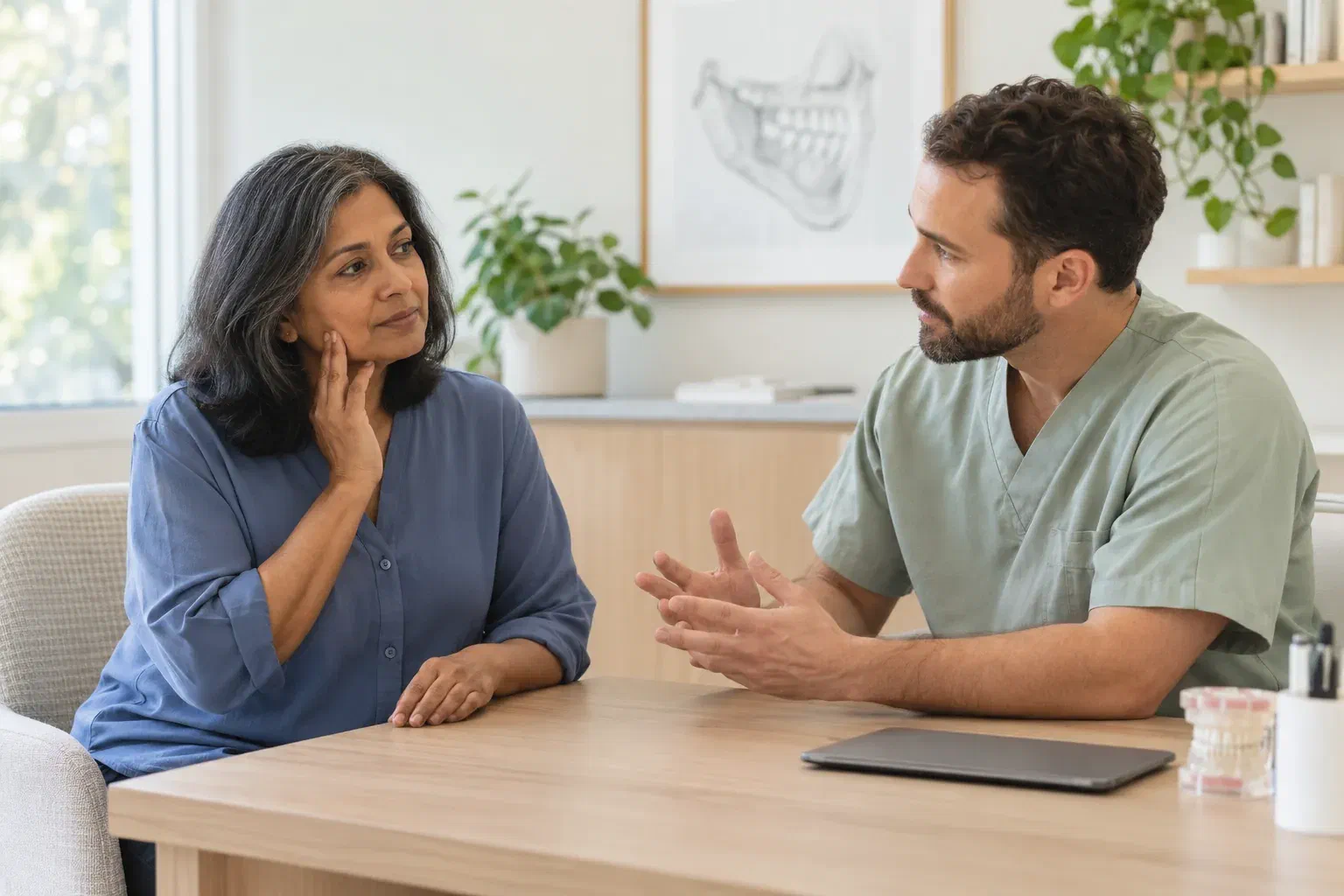
When you contact us from Puslinch, tell us about the injury first, even if it was a while ago. If it was recent and symptoms are significant, we will advise on urgent care. For lingering problems, we take a history, examine the teeth and jaw, explain what we find and what remains unclear, and agree on a sensible first step.

Get advice about jaw symptoms after an injury
Illustrative wrapped comfort pack and notebook for a home-care discussion
What changed after the injury

Compare how your jaw works now with how it worked before.

The details of the injury and what has changed since help us decide what to check and how quickly. Please avoid testing a sore jaw over and over; describing it is enough.

Pain that has lingered or crept into daily life

Where does it hurt now, compared with right after the injury? When does it flare, and does rest help? We check the teeth and surrounding structures as well as the joint and muscles, because pain near the jaw after trauma can have more than one source.

Reduced opening, a bite that feels different, or catching

Mention if your teeth no longer meet the way they used to, if opening is limited or if the jaw catches. Do not force it or try to reposition it yourself. A sudden inability to open or close, or a bite that has clearly changed since the injury, needs prompt assessment.

New clicking, or care that has not resolved things

Tell us whether clicking began after the injury and whether it hurts. Describe any treatment since, such as a guard, exercises, medicines or dental repairs, and what each changed. A click with no pain and no restriction is usually not something that needs treatment.

After any facial injury, seek urgent care for inability to eat or drink, significant swelling, fever, numbness, or new and worsening symptoms. Difficulty breathing, a head injury or another serious emergency needs emergency services first.

Moving on from the injury

Understand the lingering problem, then work on it steadily.

Once urgent concerns are cleared, a helpful plan names what you want to get back to. Chewing a steak, playing your sport without bracing, or getting through a workday without an ache along the jaw. That goal lets you ask how each suggestion connects to it, and how you will both recognise progress.

Conservative care is a common and reasonable starting point for lingering symptoms, but it should be specific and reviewed. You should know what each measure involves, why it is included and when we will check in. If symptoms change or the plan is not helping, returning to reassess is simply part of the process.

Patient information: NIDCR — TMD assessment and conservative treatment principles

A clear explanation of the findings

We describe whether the signs suggest a joint, muscle, tooth or other source, and whether imaging or another assessment would help answer a specific question. Some things only become clearer with time, as swelling settles and healing progresses. We will say plainly what we know, what we suspect and what we do not yet know.

A gradual plan you can adjust

Home measures, movement guidance and other conservative options are chosen for your findings and your stage of recovery. Ask what to do if something increases pain. The plan should evolve as you heal and respond, rather than staying fixed.

Considered choices about further treatment

If an appliance, a referral or a procedure is raised, ask about its aim, the evidence behind it, alternatives and limitations. Repairing a tooth damaged in the injury is one goal; easing jaw pain is another. No option should be presented as a guaranteed cure.

Our approach after trauma

Check for urgent problems, then look at the jaw as a whole.

Bring any reports from the emergency department, physician or other dentist, plus imaging results and any appliance. Let us know if opening wide or lying back is painful so we can take breaks.

  1. Talk through the injury and since

    We ask how and when the injury happened, what care you received, how symptoms have changed, and about health conditions, sleep and medicines. This helps us see what still needs answering and whether earlier advice still fits your situation.

  2. Examine teeth, bite and jaw function

    We may check the teeth for damage, how they meet, the range of jaw movement, the joints and the muscles. Imaging is considered when it would answer a clinical question. Tell us when a movement reproduces your usual pain, and never push beyond comfort.

  3. Plan treatment and any coordination

    We explain what we found and agree on a measured approach, which may include repairing a damaged tooth and conservative jaw care. You leave with practical instructions. If a physician, specialist or physiotherapist should be involved, we explain what they would assess.

  4. Review as recovery continues

    At follow-up we look at what you used and how symptoms have changed. Slow progress may mean adjusting the plan, reconsidering the diagnosis or seeking further assessment. Next steps follow your recovery, not an automatic timetable.

While the jaw recovers

Gentle use now, a steady return to normal later

Follow advice built for your examination and your injury. A generic exercise clip, a borrowed guard or online alignment advice should not replace guidance made for your situation.

Go easy on the jaw while it is sore

Softer foods for a while and avoiding gum or very wide bites may help during recovery. Ask when to bring firmer foods back, and how to pace heavier chores or sport around a sore jaw on a Puslinch property or job site. Constantly checking how the jaw moves tends not to help, but normal everyday use is generally fine.

Apply comfort measures as instructed

If heat, cold, massage or exercises are suggested, confirm the technique, timing and when to stop. Use a cloth between skin and any hot or cold pack, and never force a painful movement. Medicine advice should account for your health and other treatments.

Report any change in bite, opening or pain

If a prescribed appliance hurts, stop using it and contact the provider. Report a change in how your teeth meet, worsening restriction, new locking or new numbness promptly. Keep the review appointment so recovery can be judged over time.

Treatment choices after an injury

Repair what was damaged, then manage what lingers.

Ask which approaches fit your findings and what is still uncertain. Reshaping teeth or permanently altering the bite is not a proven TMD treatment, and continuing pain does not by itself mean surgery is required.

For lingering muscle or joint symptoms

Supported conservative management

Advice on comfortable jaw use, temporary food changes, habits, relaxation and guided movement can support recovery. We set a review point. If progress stalls or symptoms change, we reassess rather than continuing unchanged.

When a specific finding supports it

An appliance or targeted treatment

Treatment for a damaged tooth may be needed in its own right. An appliance may be considered for a particular purpose, but relief of TMD pain is not guaranteed. Ask about design, limits and review, and be wary of devices meant to change your bite permanently.

When the injury or response needs more expertise

Medical, physiotherapy or specialist care

Some injuries warrant input from a physician, oral surgeon or physiotherapist. Find out what the referral will look at and how information will be shared. More invasive procedures are for carefully assessed situations, with discussion of risks, alternatives and another opinion.

Jaw problems after injury

Questions people ask after a knock to the face

Injuries affect the jaw in different ways. Understanding your findings, and checking for anything urgent first, is more useful than assuming one cause.

(905) 876-4488
Should I see a dentist or go to emergency after hitting my jaw?
Go to emergency for breathing difficulty, a head injury, heavy bleeding, inability to close your mouth or other serious symptoms. For a chipped tooth or milder soreness, contact a dentist promptly for advice.
Can an old injury cause jaw pain years later?
It is possible for a past injury to be part of the picture, though other factors such as clenching habits, dental problems or general health may also be involved. Tell us about it, even if it seems minor or happened long ago, and mention any treatment you had at the time.
My bite feels different since the fall. Is that serious?
A change in how your teeth meet after trauma should be assessed promptly, as it may indicate damage to teeth or the jaw. Do not try to force the bite back into position.
When is it okay to return to contact sports?
That depends on your injury and findings, and sometimes on advice from your physician, particularly if there was any head injury. Ask us about properly fitted mouthguard options and when it would be reasonable to return, so the jaw and teeth are better protected next season.
Will a splint speed up recovery from a jaw injury?
Not necessarily. An appliance may have a role in some situations, but its benefit is not guaranteed. Ask what it is meant to do and how its effect will be reviewed.
Do I need imaging after a jaw injury?
Sometimes. Imaging may be suggested if the history or examination raises a question it could answer, such as possible damage to a tooth root or the jaw. Ask what it is intended to show.
Contact us from Puslinch

Tell us about the injury, then the ache.

Reach Milton Dental Clinic about jaw pain, stiffness or catching that started after an injury, or about a bite that feels different. Bring any reports and imaging, and we will advise on urgency and plan an assessment around your recovery.

Care is individualized and may include urgent referral, conservative steps, review or coordination.

Visit Milton Dental Clinic
Unit 1, 342 Bronte St. S, Milton, ON L9T 5B7
Get directions Clinic hours
Monday–Thursday
11am–7pm
Friday–Sunday
By appointment only

Areas we serve

  • Milton
  • Oakville
  • Mississauga
  • Georgetown
  • Halton Hills
  • Acton
  • Campbellville
  • Brampton
  • Burlington
  • Puslinch
  • Rockwood
  • Erin
  • Caledon
  • Etobicoke
  • Old Milton
  • Bronte Meadows
  • Timberlea
  • Dorset Park
  • Dempsey
  • Clarke
  • Beaty
  • Coates
  • Harrison
  • Scott
  • Willmott
  • Ford
  • Bowes
  • Cobden
  • Walker
  • Mountain View
  • Milton Heights
  • Hawthorne Village
  • Valley View
  • Fallingbrook
  • Nassagaweya
  • Trafalgar
  • Esquesing
  • Nelson
  • Brookville
  • Moffat
  • Glen Williams
  • Norval
  • Limehouse
  • Stewarttown
  • Ashgrove
  • Hornby
  • Silver Creek
  • Speyside
  • Scotch Block
  • North Oakville
  • River Oaks
  • Glen Abbey
  • West Oak Trails
  • Palermo
  • Bronte Creek
  • College Park
  • Joshua Creek
  • Uptown Core
  • Preserve
  • Iroquois Ridge
  • Lisgar
  • Meadowvale
  • Meadowvale Village
  • Churchill Meadows
  • Erin Mills
  • Central Erin Mills
  • Streetsville
  • East Credit
  • Creditview
  • Heartland
  • Sheridan
  • Mount Pleasant
  • Credit Valley
  • Huttonville
  • Churchville
  • Springbrook
  • Northwest Brampton
  • Bram West
  • Fletcher's Meadow
  • Fletcher's Creek South
  • Alton Village
  • Orchard
  • Millcroft
  • Headon Forest
  • Tansley
  • Brant Hills
  • Tyandaga
  • Kilbride
  • Lowville
  • Aberfoyle
  • Morriston
  • Arkell
  • Hillsburgh
  • Freelton
  • Carlisle
  • Waterdown
  • Flamborough
  • Mountsberg

How can we help?

Milton Dental Clinic

Have a question about your smile? Choose the option that works best for you.

For urgent dental concerns, please call.
Messages are reviewed during clinic hours.